
A Roll Short: The Thin Line of Dignity
- Aug 11, 2025
- 3 min read
Updated: Sep 13, 2025
We all use the toilet. Even people experiencing homelessness (whaaa?!).
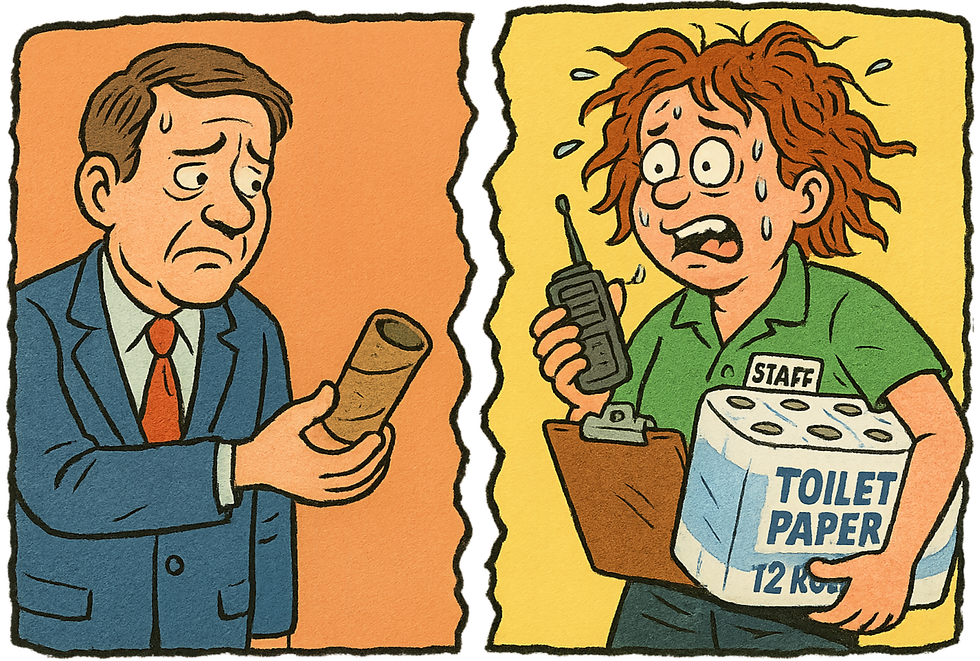
We don’t think much about it… until it’s gone. Maybe you’ve been there: you finish your business, look over, and realize you’re staring into the empty cardboard tube of regret. In normal life, you grab another roll from the closet or the next stall. In shelter life? Not so simple. The absence of that roll isn’t just an inconvenience — it’s a daily reminder of how even basic dignity depends on a system that might already be failing.
Shelter Life & the Toilet Paper Trap

If you’ve never worked or lived in a shelter, you might not realize that toilet paper is basically a currency. It’s always being asked for, it’s always running low, and it eats up more of the budget than you’d think.
When you’ve got 30–50 residents — plus staff, volunteers, and visitors — that’s a lot of wiping. But here’s the kicker: in a shelter, if you run out, you can’t just “grab another roll.” When inventory is inconsistent, the result is far more than just operational strain. Inconsistent toilet paper supply doesn’t just jam up the operations — it chips away at the daily dignity of everyone inside. An indignity born of a bureaucracy stretched past its design.
The Intersection of Dignity & Logistics
Shelter life already means people have to ask for shampoo, a toothbrush, food, even a shower. Adding toilet paper to the list is… special. It’s an unnecessary erosion of dignity for both staff and guests.
For Guests: Having to ask for toilet paper turns a private act into a public request, stripping away autonomy in a moment where dignity is already fragile.
For Staff: In shelters with 30–50+ residents, a missing roll can derail an entire shift — especially if retrieving it means walking across the building and getting pulled into any number of things along the way.
For Operations: Toilet paper is a “consumption escalator” — the more you have, the more gets used, and the cost never goes away. Without a plan, you’re always one short week away from shortage.
Why the System Struggles
Most direct-service nonprofits don’t have robust inventory management systems, or any inventory management tools at all. Toilet paper falls into this strange gap where it’s everyone’s job and no one’s responsibility. It’s not on a predictable order cycle, there’s never enough room to store what’s needed and ordering is done in crisis mode. This is how a $0.50 roll of paper becomes a $50 problem in staff time and operational disruption.
The Least-Terrible System I’ve Found
After more toilet paper crises than I care to admit, the only system that’s worked consistently is PAR Inventory — Periodic Automatic Replacement.
Measure your usage: Start by figuring out how much you actually use. Check past invoices or start collecting receipts to see your ordering habits. Try to nail down whether you’re ordering weekly or monthly — storage space will play a big role here.
Set your PAR level: Once you know how much you typically need for your chosen time frame (two weeks, a month, etc.), you can set your PAR level — the standard amount you need to operate for that period, and the number you should always aim to keep in stock.
Reorder to maintain PAR: For example, if your PAR is 20 rolls, and you count 12 rolls during inventory, you order 8 more to bring you back to PAR.
Stay consistent and adjust: Do inventory on a consistent schedule — no exceptions. If usage trends up or down, adjust the PAR accordingly. With this system, you’ll stay regulated: if you’ve got plenty left over, you order less next cycle; if you keep running short, you increase your PAR.

Why This Matters Beyond the Porcelain Throne
This is about a systems that can underpin dignity in shelters. If we can’t reliably manage the smallest, most basic items, how can we expect to succeed in meeting larger needs? Proper preparation prevents poor performance — even in the bathroom.
When the basics fail, it’s never just an inconvenience — it’s an operational distraction, a staff stressor, and for guests, one more reminder that their dignity depends on someone else’s process.
I’ve seen the ripple effects of missing basics. I’ve also seen how a simple inventory system can prevent those ripples from turning into waves. Shelter work is hard enough without making dignity a variable.
If your organization struggles with supply management or operational consistency, I help nonprofits design flexible, sustainable systems that keep the basics covered — so you can focus on impact!


Comments